 855.446.0033


Plastic Cards
Category: Plastic Card Basics
Table of Contents
- Introduction
- Quick Definition
- Characteristics of Plastic Cards
- Common Types of Plastic Cards
- Plastic Card Materials
- Standard Card Sizes
- Card Thickness
- Printing Technologies
- Personalization Options
- Security Features
- Business Applications
- Frequently Asked Questions
- Related Encyclopedia Entries
Introduction
Personalized plastic cards have become an essential part of modern life. From the loyalty card in your wallet and the hotel key card in your pocket to employee ID badges, membership cards, gift cards, and access credentials, plastic cards are used every day by businesses, schools, healthcare organizations, government agencies, hotels, retailers, and countless other industries.
Their popularity comes from a unique combination of durability, professional appearance, and versatility. Unlike paper cards, plastic cards resist moisture, tearing, fading, and everyday wear while providing a premium look and feel. They can also incorporate a wide range of technologies—including barcodes, QR codes, magnetic stripes, RFID, NFC, signature panels, and sequential numbering—to support identification, access control, payment systems, marketing programs, and customer loyalty initiatives.
Although plastic cards may appear simple, they are the result of carefully engineered materials, precision printing, and specialized manufacturing processes. Different card constructions, thicknesses, finishes, and personalization options allow organizations to create cards tailored to virtually any application.
This encyclopedia entry introduces the fundamentals of plastic cards and serves as the starting point for understanding the many technologies, materials, and manufacturing methods explored throughout The Plastic Card Encyclopedia™.
Whether you’re ordering custom plastic cards for your business, designing artwork, comparing card materials, or simply interested in how plastic cards are manufactured, this guide provides a solid foundation for exploring the entire encyclopedia.
Quick Definition
A plastic card is a durable card manufactured from synthetic materials such as composite plastic, PVC, PET, or other engineered plastics. Plastic cards are typically printed with custom graphics and may include personalization features such as names, photographs, barcodes, QR codes, magnetic stripes, RFID technology, NFC chips, signature panels, or sequential numbering.
Because of their strength, durability, and ability to support advanced technologies, plastic cards are widely used for identification, access control, customer loyalty programs, gift cards, membership programs, employee credentials, hotel key cards, and many other business applications.
Plastic cards are commonly produced in standardized dimensions—most notably the CR80 format, which is the same size as a standard credit card. This universal size ensures compatibility with printers, card readers, access control systems, wallets, and protective holders.
Why Plastic Cards Remain So Popular
Despite the rapid growth of smartphones, mobile wallets, and digital identification systems, plastic cards continue to play a vital role across countless industries. Their familiar format, long service life, and ability to combine printed information with electronic technologies make them one of the most practical identification and communication tools available.
Plastic cards are easy to distribute, convenient to carry, and immediately recognizable by customers and employees alike. Unlike many digital alternatives, they require no battery, internet connection, or specialized device to display essential information. They can also be used alongside digital systems, allowing organizations to combine physical credentials with modern technologies such as RFID and NFC.
For businesses, plastic cards offer another important advantage: branding. High-quality printing, premium finishes, and durable construction create a lasting impression while reinforcing a company’s professional image every time the card is used.
Characteristics of Plastic Cards
Plastic cards are designed to withstand everyday handling while maintaining their appearance and functionality over an extended period. Unlike paper or cardboard cards, they are manufactured from durable synthetic materials that resist moisture, tearing, bending, and surface wear, making them suitable for applications that require frequent use.
Most plastic cards share a standardized size and shape, allowing them to fit comfortably in wallets, purses, card holders, and identification badge accessories. Their consistent dimensions also ensure compatibility with printers, barcode scanners, magnetic stripe readers, access control systems, and other card-processing equipment used throughout the world.
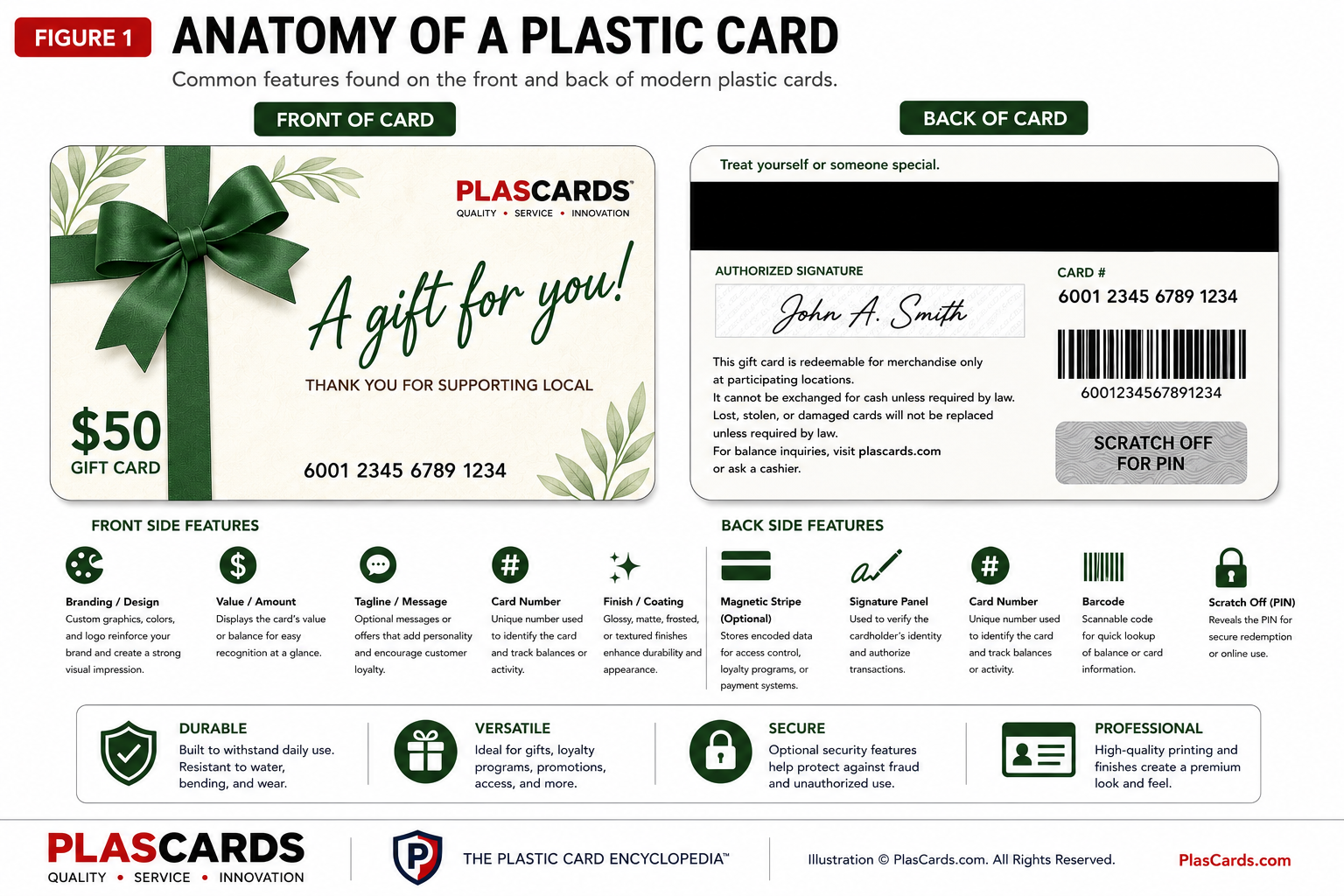
Figure 1. Modern plastic cards can incorporate a wide variety of printed, personalized, and security features. The specific features included depend on the card’s intended application, whether it is used as a gift card, membership card, loyalty card, employee ID, hotel key card, or access credential.
Note: Not every plastic card includes every feature shown. Features vary depending on the card’s purpose and application.
Depending on the intended application, a plastic card may be produced as a simple printed identification card or enhanced with a variety of personalization and security features. These can include barcodes, QR codes, sequential numbering, signature panels, magnetic stripes, RFID technology, NFC chips, holographic elements, and other features designed to improve identification, security, or user convenience.
One of the greatest advantages of plastic cards is their versatility. The same basic card can serve many different purposes simply by changing its design, printing, or personalization. For example, a standard CR80 plastic card can function as a membership card for a fitness center, a hotel room key, an employee identification badge, a gift card, a customer loyalty card, or an electronic access credential.
As manufacturing technologies continue to evolve, plastic cards remain one of the most adaptable identification and communication tools available to businesses and organizations across virtually every industry.
Common Types of Plastic Cards
Plastic cards are used in virtually every industry and can be customized to perform a wide variety of functions. While the physical card itself may look similar from one application to another, the printed design, personalization, embedded technologies, and intended purpose can vary significantly.
Some plastic cards are designed primarily to identify people, while others provide access to buildings, track customer loyalty, store gift card balances, or promote a company’s brand. Many organizations also combine several functions into a single card, allowing one credential to serve multiple purposes.
Below are some of the most common types of plastic cards used today.
Gift Cards
Business gift cards are among the most recognizable types of plastic cards. They allow customers to purchase prepaid value that can be redeemed for products or services. Many retailers use gift cards not only as a convenient payment option but also as an effective marketing tool that encourages repeat business and introduces new customers to their brand.
Loyalty Cards
Loyalty cards help businesses reward repeat customers by tracking purchases, accumulating points, or providing exclusive discounts and promotions. They are widely used by retail stores, restaurants, grocery chains, pharmacies, and service providers.
Membership Cards
Membership cards identify individuals who belong to a particular organization, club, association, gym, or professional group. They often display the member’s name, membership number, expiration date, and organization branding.
Employee ID Cards
Employee identification cards help organizations verify identity while promoting workplace security. Depending on the organization, they may include employee photographs, department information, barcodes, magnetic stripes, RFID technology, or NFC capabilities for building access and time attendance.
Hotel Key Cards
Hotels commonly use plastic key cards that contain a magnetic stripe or RFID technology to provide secure access to guest rooms and hotel facilities. These cards can be programmed, reprogrammed, and reused efficiently for each guest stay.
Access Control Cards
Access control cards are used to manage entry into secure buildings, offices, parking facilities, schools, healthcare institutions, and other restricted areas. They often utilize RFID or NFC technology to communicate with electronic access control systems.
Event & VIP Passes
Plastic event badges and credentials are frequently used for conferences, concerts, trade shows, sporting events, and VIP experiences. Their durability and professional appearance make them an excellent alternative to disposable paper badges while also serving as lasting keepsakes.
One Card — Many Possibilities
One of the greatest advantages of plastic cards is their versatility. A standard plastic card can often perform multiple functions at the same time. For example, an employee ID card may also provide building access, record attendance, operate vending machines, and identify the cardholder—all while displaying company branding.
This flexibility allows organizations to create custom solutions tailored to their operational needs without changing the familiar size or format of the card itself.