 855.446.0033


History of Plastic Cards
Category: Plastic Card Basics
Reading Time: 10–12 minutes
Table of Contents
- Introduction
- Early Card-Based Identification
- The Transition to Plastic
- Commercial Plastic Card Printing
- Standardization of Card Sizes
- The Magnetic Stripe Revolution
- Digital Personalization
- RFID, NFC & Smart Card Technologies
- Plastic Cards Today
- Future of Plastic Cards
- Timeline of Major Milestones
- Frequently Asked Questions
- Sources and References
- Continue Exploring
Introduction
Although custom plastic cards have become an everyday part of modern life, their origins can be traced back more than a century. Long before plastic became the preferred material, businesses and organizations issued paper, cardboard, and metal cards to identify members, verify customers, and provide access to exclusive services.
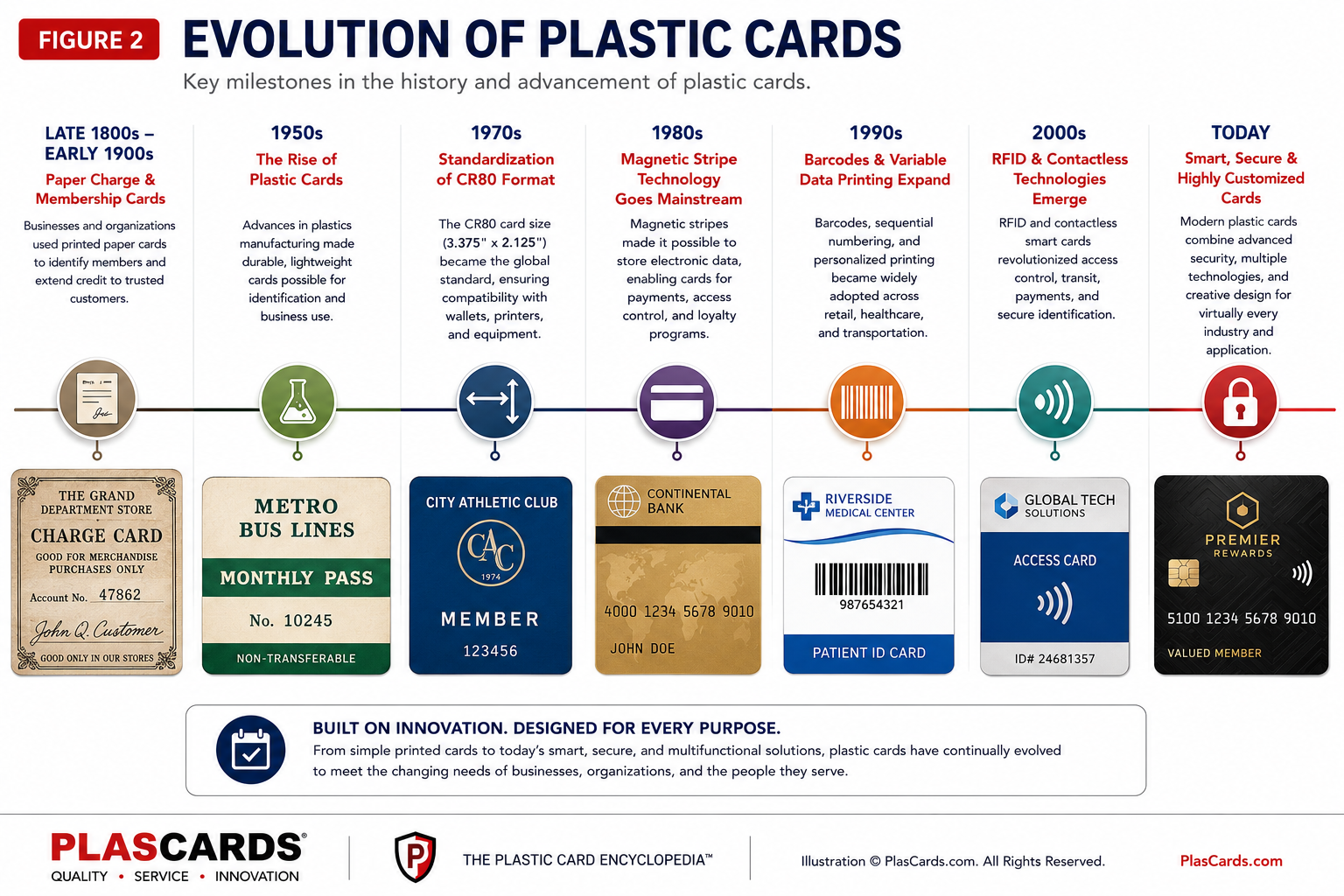
Figure 1. Plastic cards have evolved from simple paper charge and membership cards into sophisticated identification, security, and marketing tools. Advances in materials, manufacturing, printing, and embedded technologies have made modern plastic cards one of the most versatile business credentials used today.
What This Illustration Shows
Figure 1 provides a visual overview of the major milestones in the development of plastic cards. While early customer credentials were typically made from paper or cardboard, advances in materials, manufacturing, printing, and electronic technologies gradually transformed them into today’s durable, multifunctional plastic cards used across virtually every industry.
The history of plastic cards reflects more than a century of innovation in identification, commerce, security, and communication. What began as simple paper charge cards and membership credentials has evolved into one of the world’s most widely used identification and transaction technologies.
Today, billions of plastic cards are used every day for retail purchases, customer loyalty programs, employee identification, healthcare, education, hospitality, transportation, access control, and countless other applications. Modern cards combine durable materials, advanced printing technologies, and sophisticated electronic components such as magnetic stripes, RFID, NFC, and smart chips to perform functions that early card manufacturers could scarcely have imagined.
The development of the plastic card industry was not the result of a single invention. Instead, it represents decades of improvements in materials science, printing technology, manufacturing processes, standardization, and electronic security. Each advancement expanded the capabilities of plastic cards while creating new opportunities for businesses and organizations around the world.
This article explores the major milestones in the evolution of plastic cards, from the earliest paper customer credentials to today’s highly customized and technology-enabled cards.
| Time Period | Milestone | Description |
|---|---|---|
| Late 1800s – Early 1900s | Paper Charge & Membership Cards | Retailers, department stores, and membership organizations issued paper cards for customer accounts, identification, and memberships. These early cards marked the beginning of portable customer credentials. |
| 1950s | Durable Plastic Cards Emerge | Advances in plastics manufacturing introduced lightweight, durable plastic cards that resisted moisture, bending, and wear. Plastic quickly became the preferred material for long-lasting identification and membership cards. |
| 1960s | Commercial Plastic Card Printing Expands ⭐ | Improvements in commercial printing, lamination, and card production made plastic cards more affordable and accessible. Businesses increasingly adopted plastic membership cards, identification cards, promotional cards, and early loyalty programs, accelerating the widespread use of plastic cards across many industries. |
| 1970s | CR80 Standardization | The CR80 card format (3.375 × 2.125 inches / 85.60 × 53.98 mm) became the industry standard, ensuring compatibility with wallets, card printers, readers, and countless identification systems worldwide. |
| 1980s | Magnetic Stripe Technology | Magnetic stripes enabled electronic data storage, allowing plastic cards to be used for payment systems, access control, hotel key cards, employee identification, and customer loyalty programs. |
| 1990s | Barcodes & Variable Data Printing | Improvements in digital printing made it possible to personalize every card with unique numbers, names, barcodes, and other variable information, greatly expanding commercial applications. |
| 2000s | RFID & Contactless Technology | RFID and NFC technologies introduced contactless communication, enabling secure building access, transit systems, attendance tracking, and faster authentication without physical contact. |
| Today | Smart, Secure & Highly Customized Cards | Modern plastic cards combine premium printing, personalization, embedded technologies, security features, and durable materials to support applications across retail, healthcare, education, hospitality, government, and countless other industries. |
Early Card-Based Identification
Long before plastic cards existed, businesses relied on paper, cardboard, metal, and fiber cards to identify customers and members. One of the earliest examples of card-based identification appeared in the late nineteenth century, more specifically in the late 1800s and early 1900s, when many retailers introduced proprietary charge accounts that allowed trusted customers to purchase goods on credit. To simplify account identification, stores issued paper charge cards bearing the customer’s name or account information.
Department stores were among the earliest adopters of these customer identification systems. Rather than carrying cash for every purchase, approved customers could present their charge card and settle their balance at a later date. While these cards lacked today’s security features, they represented one of the earliest examples of portable customer credentials.
Membership organizations soon adopted similar practices. Fraternal organizations, social clubs, libraries, professional associations, and transportation companies issued printed membership cards that verified a person’s affiliation and granted access to services or facilities. These early cards were typically manufactured from heavy paper or cardboard and were often laminated or reinforced to improve durability.
As the popularity of card-based identification grew, manufacturers experimented with more durable materials, including vulcanized fiber, celluloid, aluminum, and other early plastics. Although these alternatives extended the lifespan of cards, they often proved expensive, difficult to manufacture consistently, or susceptible to cracking and discoloration over time.
Despite these limitations, the concept of carrying a standardized identification or membership card had become firmly established decades before modern plastic cards entered the market. These early innovations laid the foundation for an industry that would eventually transform commerce, security, and identification around the world.
The Transition to Plastic
By the middle of the twentieth century, businesses were searching for a more durable alternative to paper and cardboard identification cards. Although these early materials were inexpensive to produce, they wore out quickly when exposed to moisture, frequent handling, and everyday use. Organizations that relied on membership cards, employee credentials, customer identification, and charge accounts needed a solution that could withstand years of regular use while maintaining a professional appearance.
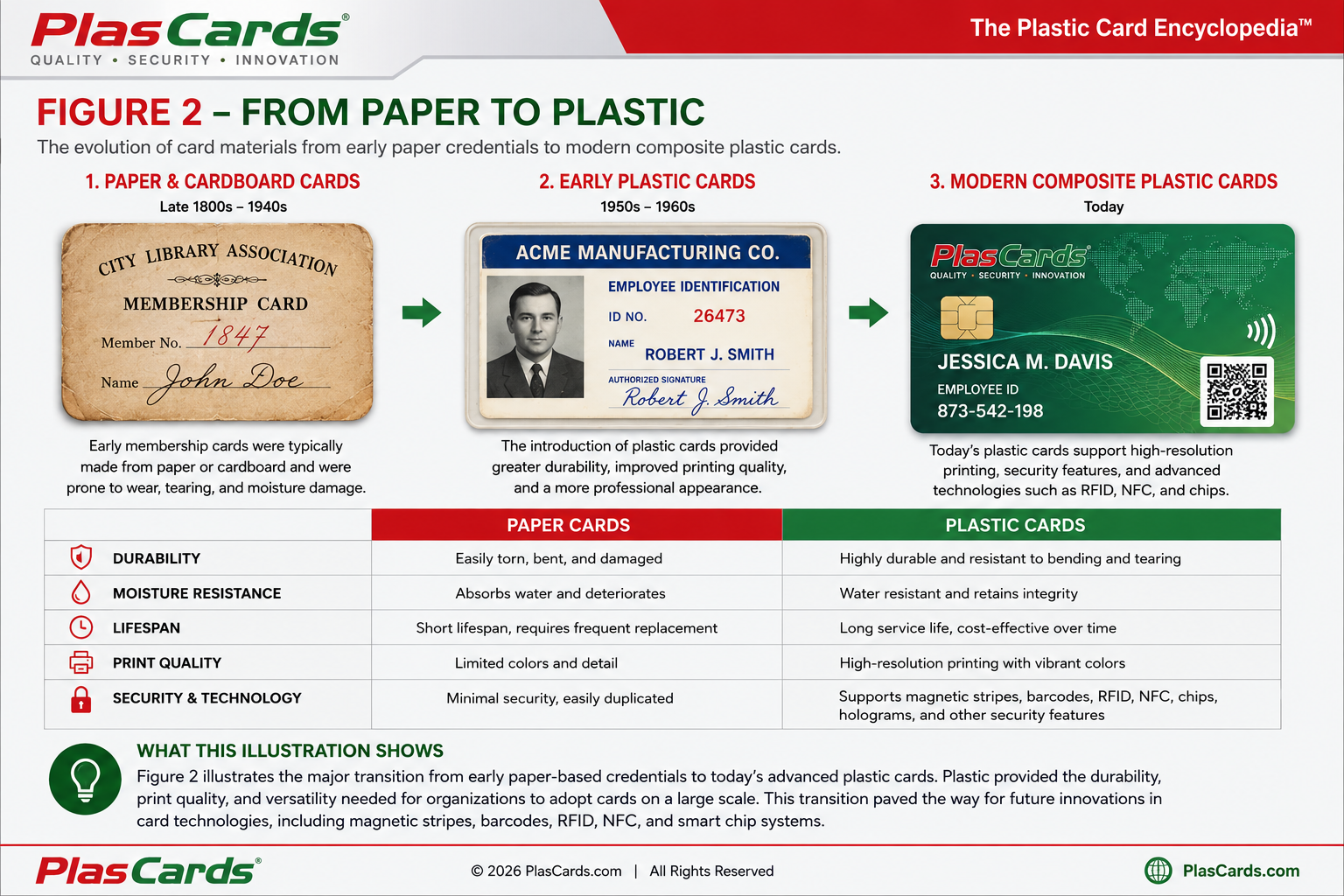
Figure 2. The transition from paper and cardboard cards to durable plastic cards marked one of the most significant developments in the history of identification and membership credentials. Plastic cards offered improved durability, superior print quality, and the ability to incorporate advanced technologies such as magnetic stripes, RFID, NFC, and smart chips.
What This Illustration Shows
Figure 2 illustrates one of the most important turning points in the evolution of identification cards. Early paper and cardboard cards served businesses well but suffered from limited durability and short service lives. As plastics manufacturing matured during the mid-twentieth century, organizations adopted plastic cards because they provided greater longevity, improved print quality, and a platform for future technologies. This transition ultimately enabled the development of magnetic stripes, barcodes, RFID, NFC, and other features that define modern plastic cards.
Advances in plastics manufacturing during the 1950s made this possible. New production techniques allowed manufacturers to create lightweight, durable cards that resisted tearing, bending, water damage, and surface wear far better than traditional paper-based alternatives. Plastic also provided a smoother printing surface, allowing sharper graphics, improved color reproduction, and greater consistency from one card to the next.
As production costs declined and manufacturing methods became more efficient, plastic cards became increasingly practical for commercial use. Businesses across a wide range of industries began replacing paper credentials with plastic versions that offered longer service life and reduced replacement costs. Membership organizations, healthcare providers, educational institutions, hotels, retailers, government agencies, and employers all recognized the advantages of durable plastic identification.
Unlike paper cards, plastic cards could also support additional manufacturing processes that would later become essential to the industry. Laminated construction improved durability and protected printed graphics, while advances in printing technologies allowed cards to be personalized with names, identification numbers, photographs, and other variable information. These innovations transformed the plastic card from a simple identification credential into a versatile communication and security tool.
By the 1960s, improvements in commercial printing, lamination, and card manufacturing had accelerated the adoption of plastic cards worldwide. What had once been limited primarily to financial institutions and large organizations expanded into retail loyalty programs, employee identification, library systems, educational institutions, hospitality, healthcare, transportation, and countless other applications. Plastic cards had become an efficient, durable, and highly customizable solution for organizations of every size.
The transition from paper to plastic did more than improve durability—it laid the foundation for nearly every modern card technology that followed. Without the strength, consistency, and precision offered by plastic materials, later innovations such as magnetic stripes, barcodes, RFID, NFC, and smart card technologies would not have been possible. The move to plastic was therefore one of the most significant milestones in the history of identification and credentialing.
Commercial Plastic Card Printing Expands
The 1960s marked an important period in the commercial development of plastic cards. Plastic cards were no longer merely an experimental alternative to paper credentials; they were becoming practical products that could be manufactured in larger quantities with greater consistency. The best-documented growth occurred in consumer charge and payment cards. BankAmericard and American Express introduced plastic general-purpose cards in the late 1950s, while Master Charge followed in 1966. Consumer credit also expanded substantially throughout the 1950s and 1960s, increasing demand for durable, professionally produced cards.

Figure 3. The expansion of commercial plastic card printing introduced organized, repeatable production methods that allowed large quantities of cards to be printed on sheets, laminated, cut, and inspected with greater consistency. These manufacturing improvements helped prepare the industry for personalization, magnetic stripes, and later card technologies.
What This Illustration Shows: Figure 3 explains how commercial plastic card manufacturing developed into an organized production workflow. Rather than producing cards individually, manufacturers prepared artwork and printing plates, printed multiple card designs together on larger sheets, aligned the printed materials and protective overlays, laminated the assembled sheets, cut them into individual cards, and inspected the finished products.
This repeatable process improved production consistency, durability, print quality, and manufacturing capacity. It also established a reliable physical platform for later innovations such as variable personalization, magnetic stripes, barcodes, and electronic card technologies.
Improvements in Commercial Production
Producing plastic cards required more than printing an image onto a plastic surface. Manufacturers had to coordinate several production stages, including artwork preparation, color separation, printing-plate creation, sheet printing, collation, lamination, cutting, and inspection.
Earlier production methods relied heavily on photographic negatives and a process known as step and repeat, in which artwork for an individual card was duplicated across a larger printing plate. Separate plates were prepared for each printing color, allowing multiple cards to be printed together on one sheet. After printing, the sheets could be collated with protective overlays, laminated under controlled heat and pressure, and cut into individual cards.
The International Card Manufacturers Association describes these older plate-making, sheet-printing, collation, and lamination methods as important predecessors of today’s digitally controlled card-production systems. Although modern equipment is faster and more precise, the fundamental idea remains similar: cards are generally produced in organized sheets and then converted into finished individual products.
Better Printing and a More Professional Appearance
Commercial printing allowed plastic cards to carry more consistent typography, logos, account information, and brand colors than many earlier paper credentials. Protective lamination could seal the printed surfaces within the finished card, reducing direct exposure to moisture, abrasion, and repeated handling.
This improved appearance was commercially significant. Cards were becoming more than functional account identifiers; they also served as visible representations of the organization that issued them. A well-produced plastic card could communicate permanence, trust, membership, or exclusivity whenever it was presented.
Growing demand also encouraged manufacturers to improve repeatability. Businesses issuing thousands or millions of cards needed each card to maintain consistent dimensions, color, surface quality, and placement of printed elements. Those requirements helped move card production toward increasingly specialized manufacturing systems rather than ordinary small-format printing.
Preparing Cards for Electronic Technology
The growth of commercial plastic-card production also created a stable platform for electronic features. During the 1960s, IBM engineers developed practical methods for attaching magnetic media to plastic cards. IBM identifies Forrest Parry as the first person to affix magnetic media to a plastic card for data storage, work that eventually helped establish the magnetic stripe as a widely used card technology.
This development changed what a commercially manufactured card could do. A card could now carry printed information for people to read while also storing encoded information for machines. That combination would later support automated banking, payment processing, hotel access, employee identification, loyalty programs, and numerous other applications.
A Foundation for a Broader Card Industry
The expansion of commercial card production during this period helped establish the manufacturing foundation for the modern plastic-card industry. Improvements in printing, lamination, cutting, and quality control made cards more practical to produce at scale, while growing commercial demand encouraged continued investment in equipment and technology.
Payment cards are the most thoroughly documented examples from this era, but the production knowledge developed around them ultimately benefited many other card categories. Similar manufacturing principles could be used for membership cards, identification credentials, transportation passes, hotel cards, and promotional applications.
By the end of the 1960s, the plastic card was no longer simply a more durable version of a paper card. It had become a standardized commercial medium capable of carrying branding, printed data, individualized information, and emerging machine-readable technology.
Historical note: “Commercial Plastic Card Printing Expands” is an editorial description of this broader period of growth, rather than the name of one officially dated invention or event.
Commercial Plastic Card Production Process
The following table summarizes the traditional production stages shown in Figure 3 above, and explains how each contributed to the growth of commercial plastic card manufacturing.
| Step | Production Stage | Purpose |
|---|---|---|
| 1 | Artwork Preparation | Graphics, text, logos, and card layouts are prepared and arranged for production. |
| 2 | Printing Plates | Separate plates are created for the colors required by the design. |
| 3 | Sheet Printing | Multiple card designs are printed together on larger production sheets. |
| 4 | Collation | Printed materials, card layers, and protective overlays are aligned in the proper sequence. |
| 5 | Lamination | Heat and pressure bond the materials into a durable sheet and protect the printed graphics. |
| 6 | Card Cutting | Finished sheets are cut or punched into individual cards with consistent dimensions. |
| 7 | Quality Inspection | Cards are checked for print quality, alignment, dimensions, surface condition, and consistency. |
Historical context: Figure 3 presents a simplified traditional commercial production workflow. Modern plastic card manufacturing may use digital equipment, automated controls, and different production sequences depending on the card material, printing method, features, and manufacturer.
Standardization of Card Sizes
As plastic cards became more widely used, manufacturers, card issuers, and equipment companies faced an important practical problem: cards produced in different dimensions could not reliably work with the same wallets, imprinters, embossing machines, readers, printers, and automated processing equipment.
A card that was slightly too wide, too narrow, too thick, or improperly shaped might fail to fit into a reader or mechanical device. Differences in corner radius, card thickness, stiffness, and surface quality could also interfere with printing, encoding, and everyday handling. The growing card industry therefore needed more than consistent printing—it needed common physical standards.
The Need for Interchangeability
Standardization allowed cards produced by different manufacturers to operate with equipment made by different companies. Once issuers and equipment manufacturers could design around a consistent card format, they no longer needed a separate system for every individual card program.
This interoperability became increasingly important as cards began incorporating machine-readable technologies. Magnetic-stripe readers, embossers, card printers, automated teller machines, access-control readers, and other devices required cards to enter the equipment in a predictable position and orientation.
Standard dimensions also benefited cardholders. A consistently sized card could fit into ordinary wallets, card sleeves, badge holders, display cases, and storage systems regardless of which organization issued it.
Early Card Standards
Several standards published during the 1970s and early 1980s addressed specific aspects of card design and technology. For example, ISO 3554:1976 covered magnetic-stripe encoding for credit cards, while ISO 2894:1980 addressed specifications for embossed credit cards. These earlier standards helped establish common practices for card dimensions, data placement, embossing, and machine-readable features.
The first edition of ISO 7810 — Identification Cards: Physical Characteristics was published in December 1985. It provided a broader international framework for the physical properties of identification cards and became the foundation for later editions of the standard.
The ID-1 Format
The format most people recognize today is formally identified by ISO as ID-1. Within the plastic-card industry, it is also commonly called CR80.
The ID-1 format measures:
- 85.60 mm wide
- 53.98 mm high
- Approximately 3.370 × 2.125 inches
- A nominal thickness of 0.76 mm, commonly expressed as approximately 30 mil
These dimensions correspond closely to the familiar size used for financial cards, gift cards, loyalty cards, membership cards, employee credentials, hotel key cards, and many access-control cards. ISO documentation also defines other identification-card formats, but ID-1 became the most familiar and widely used for wallet-sized applications.
More Than Width and Height
Card standardization involves much more than establishing the outer dimensions. ISO/IEC 7810 addresses physical characteristics including card materials, construction, dimensional tolerances, bending stiffness, resistance to chemicals, dimensional stability, adhesion, warpage, heat resistance, and surface distortions.
Related standards define other card characteristics, including the placement and encoding of magnetic stripes, embossed characters, integrated circuits, and other machine-readable technologies. Together, these standards allow physical cards and card-processing equipment to function more consistently across manufacturers, industries, and countries.
How Standardization Expanded the Industry
The adoption of common card formats helped accelerate the growth of the plastic-card industry. Equipment manufacturers could design printers, readers, encoders, and accessories around predictable dimensions. Card manufacturers could produce credentials for many different applications using established tooling and production systems.
Organizations also gained greater flexibility. A hotel, retailer, school, employer, or membership organization could order customized cards while still using broadly compatible holders, printers, readers, and personalization equipment.
Standardization did not make every card identical. It created a common physical platform upon which manufacturers could add different materials, graphics, personalization, finishes, magnetic stripes, barcodes, RFID components, NFC technology, and security features.
By separating the card’s standardized physical format from its customized purpose, the industry created a product that could remain familiar and interoperable while continuing to evolve technologically.
Historical Significance
The standardization of identification-card dimensions was one of the most important developments in plastic-card history. It helped transform plastic cards from individually designed proprietary credentials into components of interconnected commercial, identification, and security systems.
The familiar wallet-sized format remains successful because it provides a balance of portability, printable surface area, durability, and compatibility. Even as magnetic stripes, smart chips, RFID, NFC, and mobile credentials have emerged, the standardized ID-1 card continues to provide the physical foundation for countless card applications.
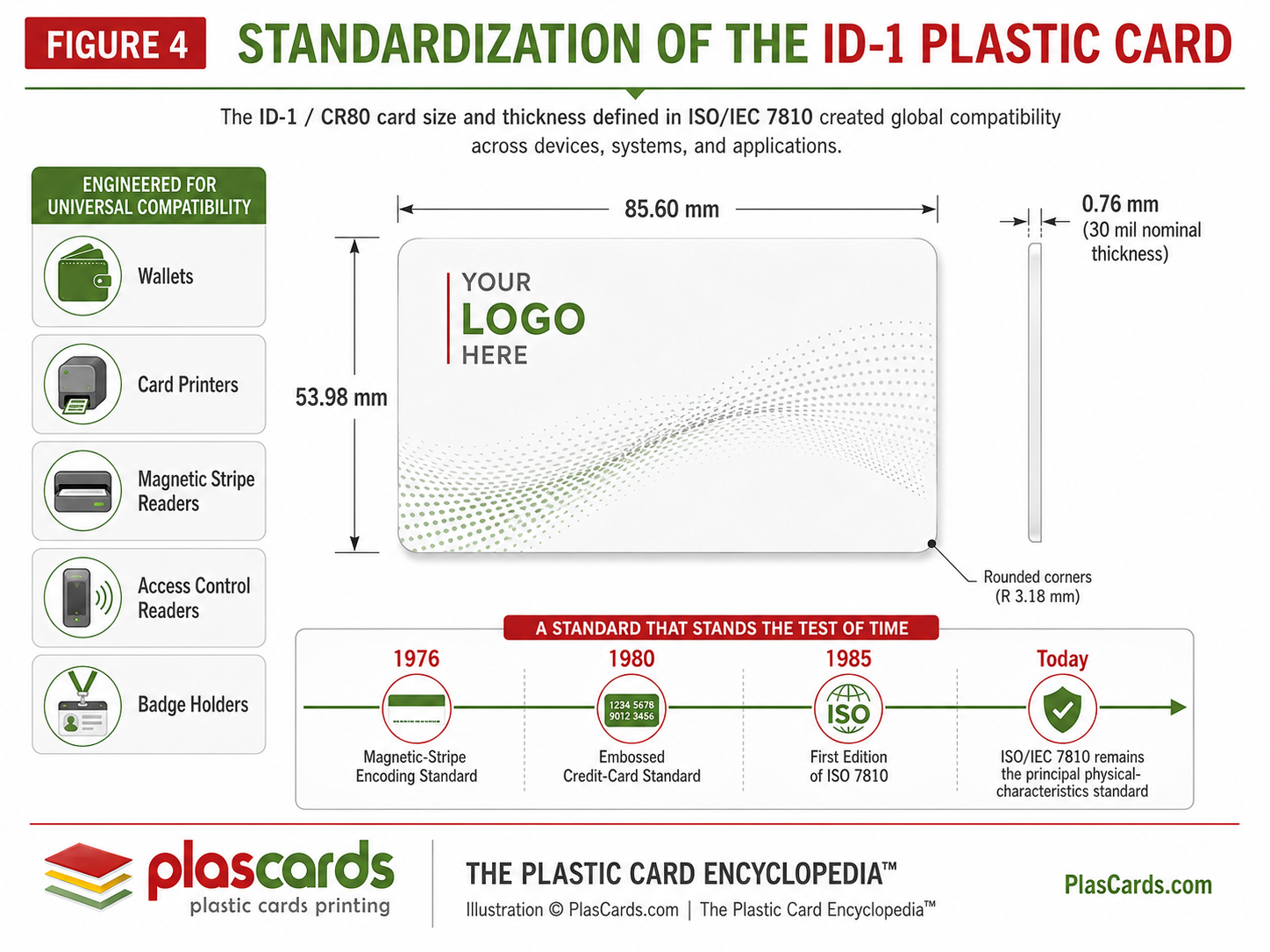
Figure 4. Standardized ID-1 card dimensions created a consistent physical format for plastic cards used with wallets, card printers, magnetic-stripe readers, access-control systems, and badge holders. The ID-1 format is commonly known within the card industry as CR80.
Understanding the ID-1 Card Standard
The wallet-sized plastic card commonly called CR80 is formally identified as ID-1 under ISO/IEC 7810. It measures 85.60 × 53.98 mm and has a nominal thickness of 0.76 mm, or approximately 30 mil.
These standardized dimensions allow cards from different manufacturers to work with compatible wallets, printers, magnetic-stripe readers, access-control systems, and badge holders. The standard provides a consistent physical format while still allowing each card to be customized with printing, barcodes, magnetic stripes, RFID, NFC, smart chips, and other features.
| Term | Meaning |
|---|---|
| ID-1 | Official ISO designation |
| CR80 | Common plastic-card industry name |
| 30 mil | Approximate nominal card thickness |
Timeline of Major Milestones in Plastic Card History
| Year | Milestone | Industry Impact |
|---|---|---|
| 1890s | Paper charge cards | Early customer identification |
| 1950s | Durable plastic cards | Improved longevity and appearance |
| 1960s | Commercial plastic printing expands | Broader adoption across industries |
| 1970s | CR80 standardization | Universal compatibility |
| 1980s | Magnetic stripes | Electronic data storage |
| 1990s | Variable data & barcodes | Personalized credentials |
| 2000s | RFID & NFC | Contactless access and identification |
| Today | Smart & secure plastic cards | Multi-function credentials |
Key Milestones
- Early paper cards introduced portable customer identification.
- Plastic materials dramatically improved durability and longevity.
- Standardized CR80 sizing ensured universal compatibility.
- Magnetic stripes transformed plastic cards into electronic credentials.
- Digital personalization expanded customization capabilities.
- RFID and NFC introduced secure contactless functionality.
- Today’s plastic cards combine advanced manufacturing, security, and branding technologies.
Related Topics
- Plastic Cards
- Composite Plastic Cards
- PVC Plastic Cards
- Card Materials
- Plastic Card Manufacturing
- CR80 Cards
- Magnetic Stripes
- RFID Cards